When to Hire a Fractional CMO for a B2B Company (and When to Wait)
It all begins with a quiet realization in the middle of a Tuesday afternoon: you are no longer just running the business; you are trying to outrun a marketing machine that refuses to stay fueled.
Maybe you have tried hiring junior marketing managers who write great blog posts but cannot answer how many pipeline dollars those posts actually produced. Maybe your ad spend has crept past the mid-five-figure mark every month while your sales team quietly whispers that the leads feel cold, disjointed, and impossible to close. Or maybe you are the visionary founder who is still acting as the default head of marketing, reviewing every landing page at midnight because nobody else quite captures the voice of your company.
Don't worry about whether you are failing at marketing. You are not failing; you have simply hit the operational ceiling of founder-led growth.
When you look at companies that scale with quiet confidence, you notice something striking. They do not guess at positioning. They do not treat lead generation as a random lottery of social media posts. Instead, they understand that building a predictable revenue machine requires a seasoned executive hand. But when your revenue sits in that dynamic mid-market band, hiring a full-time, seasoned Chief Marketing Officer can feel like bringing a sledgehammer to a delicate puzzle: costing $250,000 to $350,000 in base salary alone before bonuses and equity.
This is precisely why ambitious founders look to hire a fractional CMO to build a demand engine rather than gambling on another unproven full-time hire or another agency that promises the world and delivers vanity metrics.
Are You Actually Ready? The Thresholds of Growth
Growth does not happen in a straight line. It unfolds in jagged, messy leaps that test your patience and your balance sheets. So how do you know when your fractional CMO for a B2B company is a necessity rather than an expensive luxury?
Let's look at the numbers and the behavioral signals.
Industry benchmarks show that the sweet spot for a fractional CMO sits squarely between $2M and $25M in annual recurring revenue (ARR), with the highest-impact ROI typically concentrated in the $3M to $20M band. Below $2M, your primary focus should remain ruthlessly locked on founder-led sales, direct customer conversations, and proving rock-solid product-market fit. Above $30M, the organizational complexity and multi-region team demands usually justify a permanent, full-time C-suite executive.

But revenue benchmarks only tell half the story. You are truly ready for strategic executive marketing leadership when you recognize these operational friction points:
• The Pipeline Gap: Your marketing spend is increasing month over month, but your pipeline coverage consistently falls below 3× quota for two straight quarters.
• The Founder Bottleneck: You: the CEO or COO: are spending more than 20% of your working week reviewing copy, managing freelancer drama, or mediating endless disagreements between sales and marketing about what constitutes a qualified lead.
• Agency Fatigue: You have hired two or three different marketing agencies, and while their monthly reports look colorful, none of them can connect their tactical output to actual closed-won revenue or sustainable enterprise value.
Be clear, be confident, and don't overthink it. When these signs converge, you need architecture, not more tactics.
Building a True Demand Engine vs. Buying Random Acts of
Marketing
There is a vast gulf between sounding professional and sounding like you.
Generic marketing agencies love to talk about brand awareness, impressions, and viral reach. They want to give you a polished facade that looks impressive on LinkedIn but leaves your sales team staring at empty calendars. Ambitious founders do not need noise; they need a predictable engine.
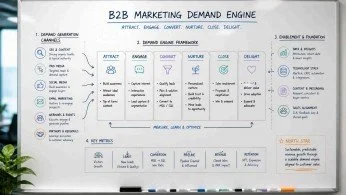
When you bring in a fractional CMO who specializes in B2B growth, the mandate shifts entirely. They do not start by redesigning your logo or shouting louder into the void. They start by diagnosing the invisible architecture of your go-to-market strategy:
1. Sharpening Your Ideal Customer Profile (ICP): Defining exactly who buys, why they buy, andwhich accounts hold the highest lifetime value.
2. Crafting Undeniable Positioning: Moving away from corporate jargon that sounds like everyone else in your industry and adopting messaging that sounds like your authentic self: direct, authoritative, and deeply empathetic to your buyers' pain.
3. Designing the Lead-to-Revenue Architecture: Connecting top-of-funnel demand generation to mid-funnel nurture and bottom-funnel sales conversion.
As you continue to evolve your business model, remember that marketing is not a department you outsource and forget. It is the lifeblood of your company's valuation. Every dollar spent on demand generation should feed an asset that increases your overall enterprise value, not just your monthly revenue.
When to Wait: Knowing When a Fractional CMO is NOT the Answer
Clarity is just as much about knowing when to pause as it is about knowing when to leap.
Sometimes, founders feel a wave of panic when growth slows down for a single quarter, and their immediate reaction is to throw executive talent at a foundational problem. If any of the following describe your current situation, take a deep breath and wait before hiring a fractional CMO:
• You Haven't Proven Product-Market Fit Yet: If you are still figuring out what your core product offering is, who actually wants to buy it, and what price point they will sustain, a fractional CMO cannot save you. Marketing only accelerates what already works; it cannot invent demand for a product that hasn't found its market.
• Your Sales Process is Completely Broken: If your sales conversion rate is near zero and your sales team cannot close inbound leads because your core value proposition is unclear, bringing in a marketing leader will only pour expensive fuel onto a broken engine. Fix your sales foundations first.
• You Lack the Budget for Execution: A fractional CMO provides high-level strategy, fractional execution oversight, and system design. If you allocate $5,000 a month for fractional leadership but have zero budget for ad spend, content creators, or sales enablement tools, the strategy will stall before it ever takes off.
Don't worry about moving too slowly. Taking the time to get your foundations right protects your capital and ensures that when you do bring in high-level leadership, the impact is immediate and undeniable.
Step Into Your Next Chapter of Scale
Scaling a privately held, low-mid market business requires courage, vulnerability, and a willingness to let go of the daily grind. You do not have to carry the weight of the entire revenue engine on your own shoulders anymore.
Whether you choose to bring in a fractional marketing leader next month or spend the next quarter refining your positioning internally, trust your instincts. Build systems that outlive your daily involvement. Create a business aligned with your personal values and your deepest ambitions.
Later will take care of itself. It always does.